

Montana license plate history begins in 1913, when the state first asked residents to register a vehicle and display a tag. The earliest plates carried numbers only, then the state added a county code in 1934 and ran with the idea ever since. Each redesign marks a decade, from the simple embossed faces of the middle of the last century to the graphic plates of the 1990s and the current 2010 design.
Montana license plate history pictures line up in the gallery once a tag sits in the light, and the designs tell a story of the state. This page walks the decades, names the designs, and shows how the county code stayed in the same spot across almost a century of change.
The First Coded Plates in 1934
Montana ran numbered plates from the start of registration in 1913, and each year brought a new color or a new style. The serials were simple digits, and the state name appeared across the bottom of some early runs. The plates of that time were embossed, with raised characters that a person could read in the light. The county code arrived in 1934. The state ranked its counties by the population count from the 1930 census and assigned the numbers from the top down. The rest of the timeline sits on the Montana License Plate site. Silver Bow County held the largest count at the time and took code 1, and Lincoln County sat at the end of the order at code 56. The list covered all 56 counties with no gaps. The order follows one rule, and that rule still shapes the numbers on the road today. A county that shrank over the decades kept its old code, and a county that boomed after 1930 kept a high number that never matched its later size. Read the code with the 1930 snapshot in mind and the odd gaps make sense.
- 1913 — the state first required registration and a plate.
- 1934 — the county code system begins, ordered by the 1930 census.
- 1956 — the state adopts the standard US plate size and bolt pattern.
- 1987 — the Centennial plate marks a hundred years of statehood.
https://mvdmt.gov/license-plate-information/The Middle Years: 1968 and 1975
The plates of the middle decades carried a bright face and a buffalo skull. A 1968 plate shows a light blue or green background with the state name in a dark band, and the skull sits at the corner. A 1975 plate swaps in a green or blue background and moves the skull to the base. Each year brought a fresh color pair, so the road carried a mix of greens and blues. These plates used the same serial formats as the earlier runs, with the county code at the left and the digits and letters filling the rest. The state changed the die style on the numbers as the decades passed, so two plates from the same decade can look slightly different. A collector who wants a clean example picks the one with the sharpest face. A plate from the 1970s still turns up on a farm truck or a trailer in storage. The aluminum holds up well, and the reflective coat from that time keeps the face readable. A driver who keeps an old plate on a vehicle should check that the design is still valid for the class, and the county office can confirm it.
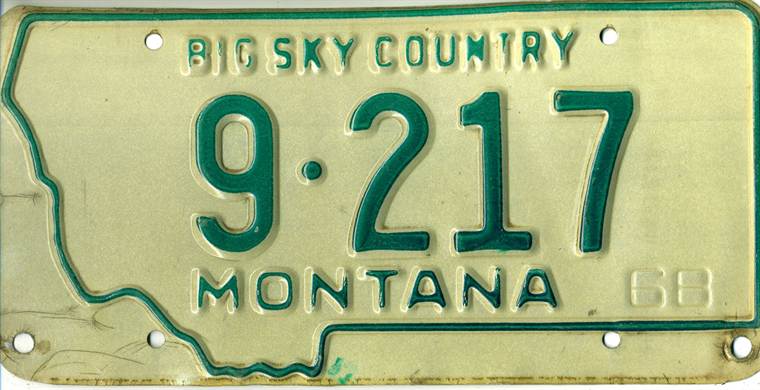
The Graphic Years: 1991 and 2004
The graphic designs began in the 1990s, and the 1991 face brought a colored band that echoed a mountain range. The state name sat in white against the band, and the serial ran in a darker tone. The 2004 design kept the gradient sky and the purple mountain range, then refined the artwork into the look that ran for years. The graphic plates used the same county code as the standard runs, so the region still read at the left edge. The artwork changed the look of the tag more than the layout. A driver who wanted a cleaner face moved to the black version, which kept the graphic theme with a darker background. The graphic years left the state a stock of designs that still issue in some cases, and a collector can build a complete set of the standard and the black versions. The Montana license plate types page lists each family and the fee that rides with it.
The Current Design from 2010
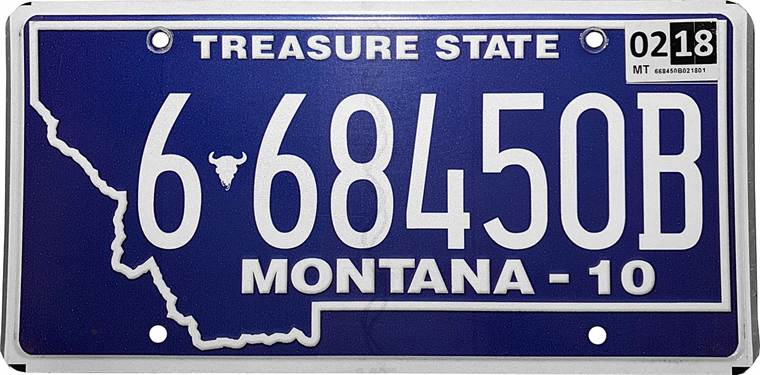
The current standard plate dates to 2010. It shows a white state outline on a blue field, with TREASURE STATE across the top and a buffalo skull between the county code and the serial. The design was a response to a mixed reception of the earlier graphic faces, and it has run for more than a decade and a half. The serial on the current face reads as county code, a dash, then a mix of digits and letters, such as 6-96872C. The state updated the serial font in 2016, so two plates from the same decade can show a slightly different look. The county code stays the same, and the reader can still place the tag in the state. The current design carries the same county code list as the 1934 snapshot, so the odd gaps remain. A driver who wants a plate that matches the current face can keep it through a transfer or a renewal. The county office updates the record and the new tag carries the same characters.
The Centennial Replica
The Centennial plate from 1987 marked a hundred years of statehood, and the state later reissued the design as a replica in an ABC123 format. The replica carries the same gold background and the mountain theme, and it drops the county code. A driver who wants a piece of the centennial history can take the replica. The replica serial uses the three-letter, three-digit pattern that the state reserves for the personalized and optional families. A driver who moves to the replica from a standard plate can keep a personal combo, and the county updates the record. The Montana personalized license plates page covers the application steps. A replica plate does not register a vehicle on its own; it pairs with a current title and a current insurance policy. A driver who adds the plate to a classic car should check the rules for the class, and the county office can confirm what the design covers.
How to Date an Old Montana Plate
Three clues date an old Montana plate. The artwork sets the broad range, the serial font narrows it, and the tab from the final year can pin it closer. A collector who reads all three can place a plate at a glance. The county code narrows the record. A code in the low digits points to the crowded belt around Butte, Helena, Great Falls and Missoula, and a code in the high digits points to the open country. The code stays with the serial through the decades, so the region reads the same on an old plate and a new one. The plate art pairs well with a title check. A buyer who reads the county on the tag can ask for the paper trail, and a clean record confirms the read. The Montana plate lookup walkthrough shows the steps from tag to record.
The Oldest Plates Still on the Road
A few older plates still see daylight on a long-held vehicle. A driver who keeps the same truck for two decades can carry an older design through many renewals. The county office updates the record and the metal can stay on the machine. A collector who finds such a plate can read its history at a glance. The oldest plates a collector meets in person are usually embossed faces from the middle decades. The raised characters give the plate a texture that a screened face does not. A collector who wants a piece from that time should check the bolt pattern and the face for wear before a purchase. A plate that sits in a garage for years keeps its shape better than one that works through winter. Storage in a dry shelf protects the reflective coat and the corners. A collector who stores a plate flat can avoid the bend that comes from a leaning stack.
How the State Shaped the Artwork
The state holds tight control over the artwork on a Montana plate. A design begins with a bill, moves through the legislature and ends with the division printing the metal. The process takes time, which is why the lineup of specialty designs shifts slowly. A driver who wants a new design can watch the session for a bill. The artwork must read at a distance, so the state keeps the lines bold and the colors simple. A design that looks strong on a screen can fail on the road, and the division reviews the face for legibility. A plate that an officer can read at a glance is a plate that serves its purpose. A cause design carries a message that the group wants on the road. The group raises money for the program and the state takes a share of the donation for the plate. A driver who picks a cause plate supports the group every time the vehicle moves. The Montana registration fee breakdown shows the lines that ride with each design.
Plate Fonts and the Change in 2016
The serial font changed in 2016, and that shift marks a clear line on the road. The older face uses a heavier type, and the newer face uses a lighter, wider set of characters. A collector who reads the font can place a plate in the first or the second half of the decade at a glance. The font change does not move the county code or the layout. The code stays at the left edge and the serial fills the rest. A plate with a new font and an old code shows a tag from after 2016 that started in the county named by the digit. That pairing is typical and easy to read. A collector who wants a matched pair should check the font on both faces of a set. A set with one old and one new face usually means a plate was replaced after damage. The Montana license plate numbers page shows how the serial block works across the runs.
Collector Tips
A collector should start with the designs that tell a story. A Centennial face, a wildlife plate or a cause design all carry a point of interest that a plain standard plate does not. A shelf with a mix of eras shows the change in the state’s artwork over the decades. Keep the paper that comes with a plate. A note with the design name, the county code and the year helps a collector file a piece and resell it later. A plate that comes with a story finds a buyer faster than a bare tag. A collector should check the metal for rust along the edge and the corners. A plate with rust through the face is a display piece, not a road piece. A buyer who wants a clean plate can ask for the condition before a purchase.
Decoding a Plate at a Glance
Read the county code first, then the art, then the serial. A tag that opens with 6 sits in Gallatin County, and a face with a purple mountain band points to the 2004 art. That pair narrows the plate to a county and a decade in one move. The tabs close the reading. A tab stamped with the final year shows the plate ran past the design run, and a clean tab on a short run often means the tag went into a drawer. A reader who checks all four pieces can date a plate in a minute. A collector who brings the reading to a swap meet can talk trade without a book. The county code names the region, the art names the decade and the serial names the office. That is the full picture on a piece of aluminum.
Frequently Asked Questions
These five questions come up most often around Montana plate history. Each answer stays short so the point lands fast.
When did Montana first require license plates?
Montana first required registration and a plate in 1913. The earliest plates carried numbers only, and each year brought a new color or a new style.
What year did Montana start using county codes?
The county code system began in 1934. The state ranked its counties by the 1930 census count and assigned the numbers from the largest down to the smallest.
What is the current Montana license plate?
The current standard plate dates to 2010. It shows a white state outline on a blue field, the Treasure State slogan and a buffalo skull separator between the county code and the serial.
What is the Montana Centennial replica plate?
The Centennial plate ran in 1987 for the state’s hundredth year, and the state later reissued the look as a replica in an ABC123 format. It carries the gold background and the mountain theme.
Can I keep an old Montana plate on a vehicle?
A driver can hold a plate through a renewal or a transfer, and an old design stays valid on a vehicle that held it through the end of its run. The county office can confirm what a specific plate covers.