

Montana license plate designs run from the standard 2010 face with its white state outline on a blue field to a black optional plate, a Centennial replica and a shelf of cause designs. Each face must stay legible at a distance, so the state keeps the lines bold and the colors simple. A design reaches the road only after a bill authorizes it and the division approves the artwork.
Montana plate designs carry the county code, the serial and the artwork together, and each family follows its own rules. This page covers the standard face, the optional and black plates, the replica, the cause families, the legibility rule, the reflective coat and the font change of 2016 that marks a clear line on the road.
How a Montana Plate Design Reaches the Road
A new design starts with a bill that authorizes the face, and the legislature passes it before the artwork begins. The rest of the topics are gathered on the Montana License Plate site. The division then draws the plate, checks it for legibility and sends a proof through review. Once the proof clears, the state prints the metal and stocks it for the county offices. A driver who wants a new face can watch the session for a bill.
- Bill — the legislature authorizes the design.
- Artwork — the division draws the face and sets the colors.
- Review — the proof must read at a distance.
- Print — the state prints the metal and stocks it.
https://mvdmt.gov/license-plate-information/A design that looks strong on a screen can fail on the road, so the division reviews the face under the conditions an officer meets. A face with thin lines or low contrast can wash out in headlights. A driver who wants a new design can send a request through the special plates advisory board, which reviews proposals and sends recommendations to the legislature.
The Standard Face from 2010
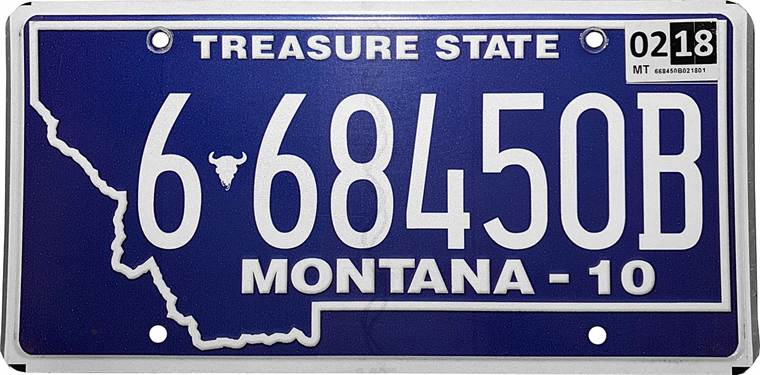
The standard plate dates to 2010. It shows a white state outline on a blue field, with TREASURE STATE across the top and a buffalo skull between the county code and the serial. The design answered a mixed reception of the earlier graphic faces, and it has run for more than a decade and a half. The serial on the standard face reads as county code, a dash, then a mix of digits and letters, such as 6-96872C. The county code sits at the left edge, and the code names the office that holds the record. A driver who reads the tag can place the county and the record from the code alone. The standard face issues in the plain version and in a black version, and both carry the same county code and serial. A driver who wants a darker face picks the optional black plate rather than the blue field. The Montana license plate types page lists each family and the fee that rides with it.
Optional and Black Plates
The optional plate carries a design the driver picks rather than the standard face, and a black version runs for a driver who wants a darker tag. The optional face drops the county code in some runs, which frees the whole face for a personal combo. The serial then reads as a three-letter, three-digit block. The optional route carries a plate fee on top of the registration, and the personal charge applies where the face carries a combo. The county issues the plate with the chosen design, and the tag renews with the vehicle. A driver who wants a clean front look can pair the face with a slim frame. A driver who picks an optional face keeps the same plate through a transfer between vehicles the same owner holds. The serial moves with the plate, and the county notes the design on the new record. The Montana license plate transfer page covers that path.
| Design family | Look | County code |
|---|---|---|
| Standard 2010 | White outline on blue, Treasure State | Shown at the left |
| Black optional | Dark field, same outline theme | Shown or dropped by run |
| Centennial replica | Gold field, mountain theme | Dropped |
| Specialty and cause | Design tied to a group or program | Shown on a standard body |
| Vintage and pioneer | Historic face for a custom build | None on the old face |
The Centennial Replica
The Centennial plate from 1987 marked a hundred years of statehood, and the state later reissued the look as a replica. The replica carries the gold field and the mountain theme, and it drops the county code. A driver who wants a piece of the centennial history can take the replica. The replica serial uses the three-letter, three-digit pattern the state reserves for the personalized and optional families. A driver who moves to the replica from a standard plate keeps a personal combo, and the county updates the record. The Montana personalized license plates page covers the application steps. A replica plate does not register a vehicle on its own. It pairs with a current title and a current insurance policy, and the county notes the design on the record. A driver who adds the plate to a classic car should check the rules for the class first.
Specialty and Cause Designs
A specialty plate carries a cause design beyond the standard face, and each one carries a donation that rides on top of the registration. The state offers a set of plates tied to universities, wildlife groups, veterans’ causes and more. A driver who picks one of those designs gives the program a share of the annual charge. A cause design must name the sponsoring organization and the program the donation supports. The state collects the personal fee and sends the donation to the group each quarter. A driver who picks a cause plate supports the group every time the vehicle moves. A wildlife face sends its donation to habitat and fisheries work, and a community face carries a town or a local group. A tribute face honors a group of people. The Montana specialty license plates page lists the designs and the charges.
Legibility and the Reflective Coat
The state puts a reflective coat on every standard plate, and the coat helps an officer read a tag at night. A design that dims the face works against the point of the coat. The division checks the contrast between the characters and the field before a proof clears. A face with a busy pattern can hide a character at a distance, so the state keeps the lines bold and the space around the serial clear. A design that crowds the county code can fail the review. A driver who wants a clean read should pick a face with strong contrast. A plate that loses its reflective coat through age or a rough cleaning reads worse at night, and a frame on top of a worn plate makes the tag harder to read. A plate faded past reading should be replaced rather than framed. The Montana replacement license plates page covers the steps.
Fonts and the Change in 2016
The serial font changed in 2016, and that shift marks a clear line on the road. The older face uses a heavier type, and the newer face uses a lighter, wider set of characters. A collector who reads the font can place a plate in the first or the second half of the decade. The font change does not move the county code or the layout. The code stays at the left edge and the serial fills the rest. A plate with a new font and an old code shows a tag from after 2016 that started in the county named by the digit. A collector who wants a matched pair should check the font on both faces of a set. A set with one old and one new face usually means a plate was replaced after damage. The Montana license plate history page walks the decades and the designs.
The Graphic Faces of the 1990s and 2000s
The graphic designs began in the 1990s, and the 1991 face brought a colored band that echoed a mountain range. The state name sat in white against the band, and the serial ran in a darker tone. The 2004 design kept the gradient sky and the purple mountain range, then refined the artwork into a look that ran for years. The graphic plates used the same county code as the standard runs, so the region still read at the left edge. The artwork changed the look of the tag more than the layout. A driver who wants a cleaner face moved to the black version, which kept the graphic theme with a darker field. The graphic years left the state a stock of designs that still issue in some cases, and a collector can build a set of the standard and the black versions. The Montana license plate gallery shows the faces side by side and lines them up by decade.
The County Code on the Face
The county code sits at the left edge of the standard face, and it names the office that registered the vehicle. The state ranked its counties by the 1930 census count and assigned the numbers from the largest down. Silver Bow County took code 1, and the list ran to 56 with no gaps. The order follows one rule, and that rule still shapes the numbers on the road. A county that shrank after 1930 kept its code, and a county that boomed later kept a high number that never matched its size. A plate that opens with 6 points to Gallatin County, and one that opens with 3 points to Yellowstone County. An optional or replica face drops the code, and the serial then fills the whole face. A driver who wants the longest personal read picks a face without the code. The Montana county code list names each office and its number.
Plate Size and the Standard Pattern
A passenger plate runs on the standard size the state shares with the rest of the country, and the mounting holes follow the same pattern. A frame or a bracket from any maker fits the holes on a standard tag. A motorcycle plate runs smaller, and a trailer plate runs narrow. The standard size lets a plate from one state fit a bracket built for another, which helps a driver who moves a vehicle across a state line. The county issues the tag on the standard body, and the artwork sits inside that frame. A custom face still measures the same as a standard tag. A plate that a frame or a bracket tilts back can hide the top row, so the mount should keep the tag square. The statute bars a plate that swings, and a snug mount with two fasteners holds the tag flat. The Montana license plate frames page covers what a frame may hide.
Decoding a Face at a Glance
Read the county code first, then the art, then the serial. A tag that opens with 6 sits in Gallatin County, and a face with a purple mountain band points to the 2004 art. That pair narrows the plate to a county and a decade in one move. The tabs close the reading. A tab stamped with the final year shows the plate ran past the design run, and a clean tab on a short run often means the tag went into a drawer. A reader who checks all four pieces can date a plate in a minute. A collector who brings the reading to a swap meet can talk trade without a book. The county code names the region, the art names the decade and the serial names the office. That is the full picture on a piece of aluminum, and a reader who learns the four pieces can place most plates on sight.
Choosing a Face for a New Vehicle
A driver who registers a new vehicle starts with the standard face, and a design applies only when the driver picks one. A driver who wants a darker tag picks the optional black plate and pays the plate fee. A driver who wants a cause face picks a specialty design and pays the donation with the registration. A driver who wants a personal combo picks a face that leaves room for the phrase. An optional or replica face drops the county code and frees the whole face. A standard face leaves the code at the left edge and the phrase beside it. A driver who wants a face the state does not list can send a request through the special plates advisory board. A new face takes several sessions to appear, since the legislature authorizes it by bill. The Montana registration fee breakdown lists the lines a driver adds for each design.
Frequently Asked Questions
These five questions come up most often around Montana plate designs. Each answer stays short so the point lands fast.
What does the current Montana plate look like?
The standard plate dates to 2010 and shows a white state outline on a blue field, with TREASURE STATE across the top and a buffalo skull between the county code and the serial.
What is the black Montana license plate?
The black plate is an optional face with a dark field and the same outline theme. It carries the county code and serial, and it runs for a driver who wants a darker tag.
Does every Montana plate show a county code?
No. The standard face shows the code at the left edge, and an optional or replica face drops it. A vintage or pioneer face carries none of the modern codes.
Who approves a new Montana plate design?
The legislature authorizes a face by bill, and the division draws and reviews the artwork for legibility. A request can go through the special plates advisory board for future sessions.
Why did the Montana plate font change in 2016?
The state moved to a lighter, wider set of characters. The county code and the layout stayed the same, so the font marks a clear line between the older and newer runs.