
Montana license plates tell you where a vehicle was registered the moment you read the first digit. The number on the left marks the county, and the letters and digits that follow identify the vehicle itself. Drivers pick between standard, specialty and personalized designs, and each one carries its own fee and renewal rule. This page collects the types, the county codes, the 2026 costs and the search options so you can settle any plate question without hopping between five different websites.
Montana license plate numbers are not random. Each county holds a fixed prefix, so a plate beginning with 7 comes from a different part of the state than one beginning with 46. Knowing the code helps when you buy a used truck, spot a familiar tag or check a vehicle’s background. The sections below walk through every plate type, the full county list, the lookup tools and the fees you pay at the treasurer’s office, with the paperwork steps in plain order.
How to Get a Montana License Plate
A first plate takes one trip to a county office and a short stack of papers, and the steps below suit new residents, first-time owners and anyone replacing a lost set. Montana issues plates through its 56 county treasurer offices, so the counter you visit depends on where you live. Start by collecting your paperwork: your certificate of title or the manufacturer’s statement of origin, a photo ID, proof of Montana residence and proof of insurance. A lender may hold the title, so carry the lien details with you. Then visit the county treasurer’s office for your county, since each county runs its own counter. Book ahead where the office takes appointments, and most rural offices serve walk-ins through the day. At the counter, staff record the vehicle identification number, the county prefix and the plate design you choose. Request a personalized or specialty design at that point, since some carry a waiting list. Pay the bill next, which combines a registration charge, a title charge and a plate charge, and personalized tags add a yearly amount on top. Most offices take debit cards and checks. Standard plates then arrive by mail in about 7 to 10 business days, and a temporary permit covers the gap until they land.
- Paperwork — title or origin document, photo ID, proof of residence and proof of insurance.
- Counter — your county treasurer’s office; book ahead where the county takes appointments.
- Cost lines — registration, title and plate charges, plus any personal or sponsored add-on.
- Delivery — standard plates by mail in roughly 7 to 10 business days.
- New residents — register inside 60 days of the move.
New residents register within 60 days of moving and hand over the out-of-state title and plates at the same visit. Confirm the current window with your county treasurer, since the rules shift from year to year.
What to bring
Bring the certificate of title or the manufacturer’s statement of origin for a new vehicle. Add a state driver license or ID card, and a lease, utility bill or bank statement that shows the Montana address. Carry a current insurance card that names the vehicle, and a debit card, check or money order, since some offices cap card payments. New residents hand over the out-of-state plates at the counter.
How long it takes
A counter visit runs about 20 to 40 minutes when the office is quiet. Standard plates arrive by mail in roughly 7 to 10 business days. Personalized designs take longer, since the state prints each set to order, and a specialty plate can sit behind a donor queue. Ask the clerk for a temporary permit so you can drive until the metal arrives.
https://mvdmt.gov/license-plate-information/What a Montana License Plate Looks Like
A passenger plate measures 12 inches by 6 inches and uses aluminum. Most cars and light trucks carry two plates, one at the front and one at the rear. Motorcycles and trailers carry a single rear plate. The 2010 design blends a light sky, dark mountain shapes and the state name, with the slogan TREASURE STATE across the top. A black background version sits beside the classic blue, and drivers can switch at renewal. Each tag prints a county prefix, a serial and a month and year decal. The decal sits in the upper corners on most designs. The state reissues standard plates on a fixed cycle, so an older tag can look different from a current one and stay valid. The serial format runs as county code, a dash, then a mix of digits and letters, such as 6-96872C for Gallatin County.
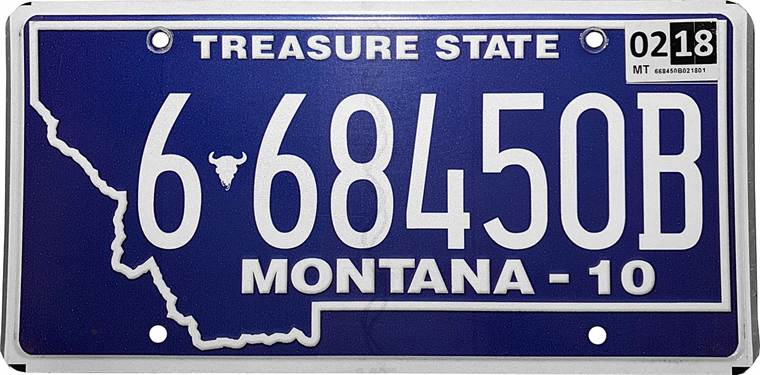
Plate anatomy
A Montana plate carries a county code of one or two digits at the left edge, then a serial of up to six characters drawn from the county block. The slogan TREASURE STATE sits on the current standard design, and month and year stickers sit in the corners. A buffalo skull acts as a separator on several designs, and every plate uses the mounting-hole pattern shared by US plates since 1956.
Montana License Plate Types and Options
Montana prints more designs than most states. A driver can hold a standard tag, a cause tag, a personalized tag or a commercial tag, and the pick changes the fee, the renewal rule and the number of plates issued. Choosing comes down to three questions: how many plates the vehicle needs, whether the owner wants a cause logo, and how much the yearly charge should be. A commuter car rarely needs more than the standard design. A truck that hauls across state lines needs a commercial or apportioned tag. A collector who wants a personal statement can move to a personalized design with a modest yearly add-on.
Standard issue
The standard plate comes with every new registration until the owner asks for another design. It carries the county prefix and a serial drawn from that county’s block. Owners can move to the black background version at renewal for a small charge.
Specialty and cause plates
Specialty plates raise money for a cause. Montana backs wildlife, parks, colleges, military service and dozens of charities. Each design adds a yearly donation on top of the standard fee, and the amount differs by program. Popular picks include the Glacier National Park plate, elk and wildlife designs, and search-and-rescue tags.
Personalized and vanity
A personalized plate lets the owner pick letters and digits. Standard plates allow up to seven characters; specialty plates allow five. The state reviews each request and rejects combinations that carry profanity, repeat an existing tag or clash with a public symbol.
Motorcycle and trailer
Motorcycles and trailers take one rear plate. Both offer standard and personalized versions, with a smaller face size for two-wheel vehicles.
Commercial and apportioned
Trucks, buses and heavy vehicles use commercial tags. Fleets that cross state lines use apportioned plates, which split registration fees across the states where the vehicle runs.
How many designs exist
Montana lists more than one hundred plate designs across all groups, and the number shifts as lawmakers add programs and retire older ones. The Montana license plate types page shows every design with its fee and character limit.
What the Numbers and Letters Mean (County Codes)
A Montana plate opens with a county code. The digits on the left point to the county that issued the tag, and the serial that follows is unique inside that county. The system dates to 1934, and the order follows county populations from the 1930 census. A plate that starts with 3 comes from Yellowstone County in Billings; a plate that starts with 46 comes from Granite County.
| Code | County | County seat |
|---|---|---|
| 1 | Silver Bow | Butte |
| 2 | Cascade | Great Falls |
| 3 | Yellowstone | Billings |
| 4 | Missoula | Missoula |
| 5 | Lewis and Clark | Helena |
| 6 | Gallatin | Bozeman |
| 7 | Flathead | Kalispell |
| 8 | Fergus | Lewistown |
| 9 | Powder River | Broadus |
| 10 | Carbon | Red Lodge |
| 11 | Phillips | Malta |
| 12 | Hill | Havre |
Optional and personalized plates use an ABC123 format, so they carry no county code. Counties with smaller populations hold codes in the forties and fifties, and the order has held steady for decades. That stability makes a plate easy to trace back to its home county, and the Montana county code list pairs each number with its county seat.
Montana License Plate Lookup and Search
A plate lookup turns a tag into vehicle data. Montana ties each plate to a county and a serial, and county treasurer offices hold the local records. Free tools return the make, model, year and open recall status, and they stop short of personal details. Owner names and home addresses are shielded by federal privacy law, so no public site hands them out.
What a lookup returns
A lookup returns the vehicle identity, which covers the make, model, model year and trim. It adds safety data such as open recalls and crash-test ratings, and title signals such as salvage, flood or rebuilt marks where the state reports them. Mileage hints can appear from service and inspection records, along with the registration status, which shows whether the tag is current or expired. To search, type the county code and serial into a lookup tool and read the vehicle summary. For title and lien records, request a motor vehicle record from the state. The Montana plate lookup walkthrough covers the search step by step.
Fees and Costs (2026)
Costs split into three parts: registration, title and the plate itself. The table shows how each piece works, and the total depends on vehicle weight, county and plate type.
| Item | How the cost works |
|---|---|
| Standard plate | Set by county and vehicle weight |
| Registration renewal | Yearly charge plus a county option fee |
| Personalized plate | $25 to start, then $10 at each transfer or renewal |
| Sponsored plate | Standard fee plus a yearly sponsor donation |
| Replacement plate | Small charge for a duplicate set |
| Permanent plate | One-time charge with no yearly renewal |
| Temporary permit | 90-day permit from the county treasurer until plates print |
Two costs catch new owners off guard. The first is the county option fee, which each county sets and which shifts with the local budget. The second is the personal property tax on vehicles, which the county treasurer collects at the same counter and which has nothing to do with the plate itself. Ask for both figures in one quote so the total does not surprise you at the till. The Montana registration fee breakdown lists every charge by plate type.
Registration and Renewal
Registration ties a vehicle to an owner and a county. New residents title the vehicle, hand over the out-of-state plates and pick a Montana design. Renewal runs on a yearly cycle, and the county mails a notice ahead of the due date. The month and year decal goes on the plate after payment, and a lost or stolen decal is replaced at the county office. Keep the registration card in the vehicle and match the address on file.
Renewal
The county mails a reminder ahead of the due date, and the same notice lists the amount owed. Some counties ask for a smog or safety check before they renew, so book that early. Pay the registration online, by mail or at the counter, and keep the receipt. Scrape the old sticker off and set the new month and year decal in its place. A move inside the state needs a fresh record so the next notice reaches you. Plate transfers, temporary tags and replacements all flow through the same county counter.
Custom and Personalized Plates
Custom plates let a driver shape the tag. Pick a design, then request a letter-and-digit combo. Standard designs allow up to seven characters, and specialty designs allow five. The state rejects profanity, existing tags and symbols tied to public agencies. Check availability before you file, since a popular combo may sit in another driver’s name.
Requesting a combo
Pick a design first, from a standard face to a specialty or a cause plate. Run a quick availability search to see whether the combo is free, then file the state form, which asks for a first and a backup pick. The state screens each request for banned content, and approved designs print to order and arrive by mail. The application asks for your pick plus a backup choice. If the first combination is taken, staff offer the second. A rejected request returns the fee, and the owner can try again with a new combo.
Permanent Plates and the Montana LLC Angle
A permanent plate ends the yearly renewal cycle. The owner pays once and keeps the tag for the life of the vehicle. Out-of-state drivers use this route with a Montana LLC: the company holds the title, the vehicle registers in the state and the plates stay valid without a yearly trip. Rules on residency, insurance and use remain in force, so review the current terms before you set up a company. The state has tightened some of these routes in recent years, and other states now challenge the arrangement when a vehicle spends most of the year elsewhere. A permanent plate suits a collector car, a farm truck or a trailer that sees light use. It fits a full-time traveler who keeps a Montana base. Read the fine print on garaging, inspection and insurance before you commit, and keep the title clean.
Front and Rear Plate Rules
Montana requires two plates on most passenger vehicles, one at the front and one at the rear. Motorcycles and trailers carry a single rear plate. Missing, covered or obscured plates draw a fine. Keep both plates clean and readable, and replace a damaged plate at the county office. Skip the tinted covers and the frames that hide the state name. A frame that blocks the county code or the decal gives an officer a reason to stop you, and a covered plate can turn a routine check into a citation. Mount the plate flat, keep the bolts tight and swap a bent plate rather than straightening it.
Frequently Asked Questions
Drivers bring the same handful of questions to the county counter. The five answers below cover the county code, plate cost, search options and the front-plate rule.
How many license plates does Montana offer?
Montana lists well over one hundred designs across standard, sponsored, military, antique, disability, amateur radio and special mobile groups. Lawmakers add new sponsored designs most sessions, so the total creeps upward each year.
What do the numbers on a Montana license plate mean?
The leading one or two digits mark the county that issued the tag. The rest of the serial is unique inside that county, so two plates from the same county never repeat. The system dates to 1934 and follows county populations from the 1930 census.
Can I search a Montana plate for free?
Free tools return the make, model, year and open recall status tied to the plate. Owner names and addresses stay private under federal law, so no public site hands them out. For title and lien records, order a motor vehicle record from the state.
How much does a Montana plate cost?
A standard plate follows county and vehicle weight, so the figure shifts by location. Personalized plates add $25 up front, then $10 at each transfer or renewal. Sponsored designs charge the standard fee plus a yearly donation set by the sponsoring group.
Does Montana require a front plate?
Most passenger cars and light trucks need two plates, one at the front and one at the rear. Motorcycles and trailers carry a single rear plate. A missing, covered or bent plate draws a fine, so replace a damaged set at the county office.